
Introduction
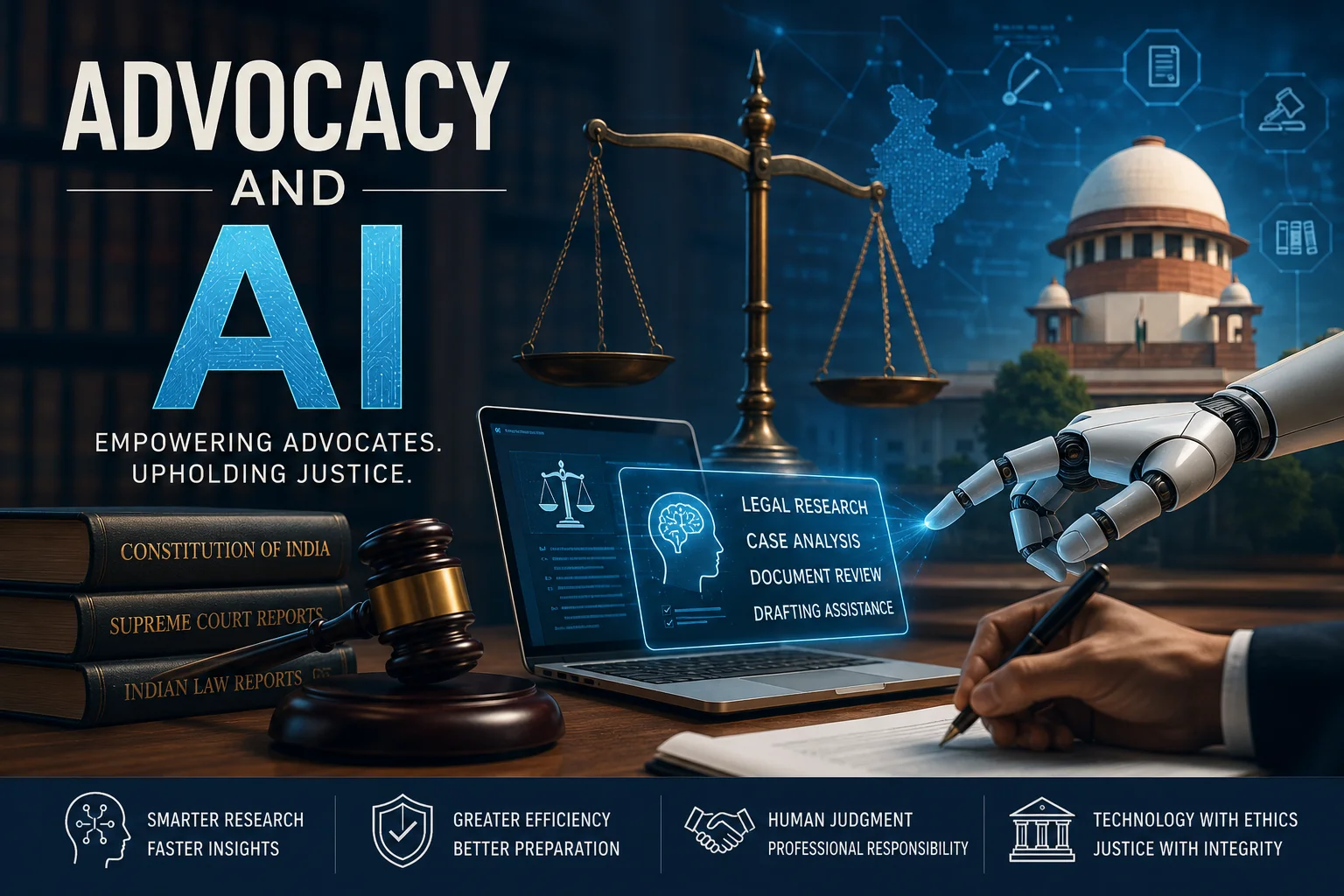
Artificial Intelligence, commonly known as AI, is no longer merely a subject of technology conferences or corporate discussions. It has entered the legal profession.
Today, an advocate can use AI to summarise lengthy documents, identify issues in a case, prepare a first draft of a pleading, organise facts, compare provisions of law, analyse large volumes of documents, and assist in legal research. Courts themselves are also exploring the use of technology and AI to improve judicial administration and access to information.
But there is an important distinction between using AI as a legal assistant and allowing AI to become a substitute for legal judgment.
This distinction has become particularly important after the landmark judgment of the Supreme Court of India in Pooja Ramesh Singh v. Jammu and Kashmir Bank Ltd. & Anr., 2026 INSC 668, decided on 2 July 2026. The Supreme Court dealt directly with the problem of AI-generated fake and hallucinated legal precedents and laid down a strong warning for both the Bar and the Bench.
The judgment does not prohibit the legitimate use of Artificial Intelligence. Rather, it establishes an important principle:
AI may assist an advocate, but responsibility for what is placed before the Court remains with the advocate.
This article examines the relationship between Advocacy and AI, the practical uses of AI for lawyers, its limitations, professional responsibility, risks of AI hallucination, and the lessons that Indian advocates should take from the Supreme Court’s latest approach.
1. What Is Artificial Intelligence in Legal Practice?
In simple terms, Artificial Intelligence refers to computer systems capable of performing tasks that ordinarily require human intelligence, such as analysing information, identifying patterns, generating text, and responding to questions.
For an advocate, AI can function as a research and drafting assistant.
For example, an advocate may use AI to:
- understand a complicated legal provision;
- summarise a lengthy judgment;
- extract facts from hundreds of pages of documents;
- prepare a chronology of events;
- identify possible legal issues;
- generate a preliminary structure for a pleading;
- compare different versions of a statute;
- prepare questions for cross-examination;
- identify inconsistencies in documents;
- prepare a first draft of written submissions;
- convert complex legal concepts into simple language;
- assist in preparing legal articles and educational material.
However, AI does not automatically know whether the information it produces is legally correct.
That is the fundamental point that every advocate must understand.
2. Why AI Is Particularly Relevant to Advocacy
Legal practice involves enormous amounts of information.
An advocate may have to deal with:
- statutes;
- rules and regulations;
- notifications;
- circulars;
- judgments;
- pleadings;
- affidavits;
- evidence;
- contracts;
- financial statements;
- correspondence;
- electronic records;
- departmental notices;
- orders of tribunals;
- procedural requirements.
The challenge is not always the absence of information. Often, the challenge is finding, organising and understanding the relevant information within limited time.
This is where AI can be extremely useful.
Consider a GST litigation matter involving several years of returns, invoices, e-way bills, notices, replies and departmental orders. Manually examining every document may consume considerable time.
AI-assisted document analysis can help an advocate create an initial map of:
Facts → Documents → Issues → Applicable Law → Possible Arguments → Missing Evidence
The advocate can then independently verify the material and use professional judgment to decide what should actually be placed before the authority or Court.
Therefore, the most useful way of looking at AI is not:
Lawyer vs AI
but:
Lawyer + AI, with the lawyer remaining in control.
3. How Advocates Can Use AI in Day-to-Day Practice
A. Legal Research
AI can help an advocate identify possible legal issues and formulate research questions.
For example, instead of starting with a broad search for:
“Cheque bounce defence”
an advocate may ask AI to identify the legal questions involved in a particular factual situation.
The advocate can then conduct independent research on authentic legal databases and official Court websites.
AI is therefore useful as a research starting point, but not necessarily as the final authority.
B. Case Law Research
One of the most valuable applications of AI is assisting with case-law research.
An advocate can ask AI to:
- identify cases dealing with a particular legal proposition;
- summarise the ratio of a judgment;
- identify relevant paragraphs;
- compare two judgments;
- identify whether a later judgment has distinguished an earlier judgment;
- prepare a case-law chart.
But this is precisely where the greatest danger exists.
A lawyer must never assume that a case citation produced by AI is genuine.
The citation must be independently checked against the actual judgment.
This is no longer merely a matter of good practice. The Supreme Court has now expressly addressed the issue.
4. The Supreme Court’s Landmark Judgment on AI-Generated Fake Case Law
The most important Indian judicial development concerning AI and advocacy is:
Pooja Ramesh Singh v. Jammu and Kashmir Bank Ltd. & Anr.
Civil Appeal No. 11950 of 2025
2026 INSC 668
Decision: 2 July 2026
Bench: Justice Pamidighantam Sri Narasimha and Justice Alok Aradhe
The Supreme Court was confronted with a serious problem: judicial decisions of the NCLT and NCLAT had relied upon legal citations that were found to be fake, non-existent, or incorrectly attributed.
The Supreme Court’s official case summary records that six citations relied upon in the NCLT proceedings were examined. Some had correct case citations but were attributed to non-existent paragraphs, one citation actually belonged to a different judgment, and three citations were entirely non-existent.
The Supreme Court consequently set aside the NCLT and NCLAT orders and directed that the matter be considered afresh.
More importantly, the Court addressed the broader question of AI in adjudication and legal practice.
Read more-
Safety of Women Advocates in Police Stations: A Step Towards Strengthening Access to Justice?
5. The Supreme Court Did Not Ban AI
This distinction is extremely important.
The Supreme Court did not say that advocates cannot use Artificial Intelligence.
In fact, the judgment recognises that AI can assist professionals and can be used in the justice system.
The concern of the Court was with unverified AI-generated material being presented or relied upon as genuine legal authority.
The Court specifically clarified that its judgment does not affect the rightful use of AI. Its concern is the presentation or reliance upon fake or hallucinated material as if it were an actual judicial precedent.
Thus, the judgment should not be misunderstood as:
“Do not use AI.”
The correct understanding is:
“Use AI carefully, verify everything, and never surrender professional judgment to AI.”
6. What Is AI Hallucination?
An AI hallucination occurs when an AI system generates information that appears convincing but is actually false, inaccurate, or unsupported.
In legal practice, this may take several forms.
For example, AI may generate:
- a non-existent case;
- an incorrect citation;
- a genuine case with an incorrect proposition;
- a genuine case with a non-existent paragraph;
- an incorrect statutory provision;
- an outdated legal position;
- a quotation which does not appear in the judgment.
The danger is that the language may sound completely authentic.
A fabricated case name may look real.
A fabricated citation may look perfectly formatted.
A fabricated paragraph number may appear convincing.
That is why ordinary proofreading is not enough.
Legal verification is essential.
7. The Supreme Court’s “Zero Tolerance” Approach
The Supreme Court adopted a very strong position regarding unverified AI-generated precedents.
According to the Court’s official judgment summary, courts must adopt a zero-tolerance approach towards producing, citing, or relying upon AI-generated precedents without verification.
The Court further held that it is misconduct for an advocate to cite such material without verification. It also stated that where fake or hallucinated material enters the judicial decision-making process, the resulting decision cannot be sustained, irrespective of whether that material had a direct or indirect bearing on the ultimate decision.
This has profound implications for legal practice.
The responsibility does not disappear merely because the advocate says:
“The AI gave me the citation.”
The Court is concerned with what the advocate placed before the Court, not with which software generated it.
8. The Advocate Remains Responsible
This is perhaps the most important professional lesson from the judgment.
An advocate may use:
- AI;
- legal databases;
- research assistants;
- junior advocates;
- law clerks;
- software;
- document-management systems.
But the advocate remains responsible for the submissions made before the Court.
Technology cannot become a shield against professional responsibility.
Therefore, if an advocate receives a case citation from an AI system, the proper process should be:
AI-generated citation → Locate the actual judgment → Verify citation → Verify relevant paragraph → Read the judgment → Check subsequent treatment → Use only after confirmation
This should become a standard professional workflow.
9. AI and Drafting of Pleadings
AI can be particularly useful in drafting.
An advocate can use AI for preparing the first structure of:
- plaints;
- written statements;
- applications;
- bail applications;
- writ petitions;
- appeals;
- objections;
- replies to show-cause notices;
- GST replies;
- written submissions;
- legal opinions;
- notices;
- affidavits.
However, AI-generated drafting should always be treated as a first draft.
The advocate must independently verify:
- jurisdiction;
- limitation;
- statutory provisions;
- facts;
- dates;
- names of parties;
- procedural history;
- reliefs sought;
- case citations;
- annexures;
- court rules;
- court-specific formatting requirements.
A beautifully written pleading containing one incorrect material fact can be more dangerous than a poorly written pleading containing correct facts.
10. AI and Legal Research: The Golden Rule
A practical rule for advocates can be stated very simply:
Never cite a judgment merely because AI has cited it.
The actual judgment should be located and examined.
For Indian litigation, preference should be given to authentic sources, particularly:
- Supreme Court of India;
- relevant High Court;
- official tribunal websites;
- India Code;
- government departments;
- statutory regulators;
- official notifications and gazettes.
The Information Technology Act, 2000, for example, provides legal recognition to electronic records and electronic signatures and forms an important part of India’s legal framework concerning electronic transactions.
But an advocate should distinguish between an AI-generated explanation of a statute and the statute itself.
The Act is the authority. AI is only an aid to understanding it.
11. AI and Confidentiality of Client Information
Another major issue is confidentiality.
Suppose an advocate uploads into an AI system:
- a client’s agreement;
- a confidential settlement proposal;
- medical documents;
- financial statements;
- privileged communications;
- defence strategy;
- internal correspondence;
- unfiled pleadings;
- sensitive personal information.
The advocate must consider what happens to that information and whether the particular AI service is appropriate for handling confidential material.
Before uploading sensitive documents, an advocate should understand:
- the platform’s data practices;
- retention policies;
- privacy controls;
- whether submitted information may be used for model improvement;
- account security;
- access controls;
- applicable professional obligations.
AI convenience should never come at the cost of client confidentiality.
12. AI Cannot Replace Advocacy
Advocacy is not merely the ability to produce words.
A good advocate must:
- understand the client;
- identify the real dispute;
- distinguish relevant facts from irrelevant facts;
- assess credibility;
- understand the Court’s concerns;
- anticipate the opponent’s arguments;
- respond to questions from the Bench;
- make strategic decisions;
- assess settlement possibilities;
- understand practical consequences;
- exercise professional judgment.
These functions require context, experience, judgment and responsibility.
AI may help an advocate prepare for these tasks.
It cannot take professional responsibility for them.
The Supreme Court’s recent judgment makes this distinction particularly important because the Court itself recognised the transformative character of AI while insisting that human control must remain central to adjudication.
13. AI and the Future of Legal Research
The traditional legal research model is changing.
Earlier, an advocate might proceed as follows:
Statute → Commentary → Case Law → Judgment
The AI-assisted model may increasingly become:
Facts → AI-assisted issue identification → Candidate authorities → Independent verification → Legal analysis → Advocacy
The important addition is:
Independent verification
Without that step, AI-assisted legal research can become dangerous.
With that step, AI can significantly improve efficiency.
14. AI Can Make a Good Advocate Better — But It Can Also Make a Careless Advocate More Dangerous
This is an important distinction.
A skilled advocate using AI responsibly may save considerable time.
For example, AI can assist in reviewing a 500-page record and identifying:
- dates;
- names;
- contradictions;
- repeated documents;
- missing documents;
- references to particular transactions.
The advocate can then verify those findings against the original record.
But a careless advocate may simply copy the AI output into a pleading.
That creates a serious risk.
Therefore:
AI amplifies the user’s working method.
If the process is careful, AI can increase efficiency.
If the process is careless, AI can increase the speed at which mistakes are made.
15. A Practical AI Protocol for Advocates
Every advocate using AI should consider adopting a simple internal protocol.
Step 1 — Use AI for assistance
Use AI for brainstorming, summarisation, organisation and preliminary research.
Step 2 — Separate facts from AI-generated material
Client facts should come from the client and original documents, not from AI assumptions.
Step 3 — Verify every legal authority
Check every case citation, paragraph, statutory provision, and quotation.
Step 4 — Read the original judgment
Do not rely solely upon an AI summary.
Step 5 — Check whether the law is still valid
A judgment may have been:
- overruled;
- distinguished;
- modified;
- stayed;
- superseded by legislation.
Step 6 — Verify procedural requirements
AI may provide legally plausible but procedurally incorrect advice.
Step 7 — Conduct a final human review
The advocate should personally review the final pleading or submission.
Step 8 — Take responsibility
Before filing, ask:
“Am I personally satisfied that every material proposition in this document is correct?”
If the answer is no, it should not be filed.
16. AI in Criminal Litigation
AI may assist criminal lawyers with:
- organising case diaries;
- analysing FIRs;
- preparing chronologies;
- comparing witness statements;
- identifying contradictions;
- preparing bail arguments;
- summarising forensic documents;
- organising evidence;
- preparing cross-examination themes.
But criminal practice requires particular caution.
A criminal case may involve:
- liberty;
- reputation;
- personal safety;
- constitutional rights;
- evidentiary questions.
An AI-generated factual assumption can therefore have serious consequences.
The original record must always prevail.
17. AI in Civil Litigation
In civil litigation, AI can assist with:
- pleadings;
- chronology;
- contractual analysis;
- issue identification;
- limitation calculations;
- document comparison;
- preparation of written submissions;
- case-law research.
For example, in a property dispute involving hundreds of pages of sale deeds, correspondence, notices and revenue records, AI may assist in creating an initial chronology.
But the advocate must verify the chronology against the original documents.
18. AI in GST and Tax Litigation
GST and tax litigation is particularly suitable for AI-assisted document analysis because cases often involve large volumes of data.
AI can assist in organising:
- GSTR-1;
- GSTR-3B;
- GSTR-2A/2B;
- e-way bills;
- invoices;
- notices;
- orders;
- ledgers;
- reconciliation statements.
Similarly, in income-tax litigation, AI may assist in analysing:
- notices;
- computation sheets;
- TDS statements;
- Form 26AS;
- AIS;
- financial statements;
- assessment orders;
- appeal records.
But tax law changes frequently.
Therefore, an AI-generated answer concerning a provision must always be checked against the law applicable to the relevant assessment year or tax period.
19. AI in IBC and NCLT Practice
IBC practice presents another area where AI can be useful.
An advocate may use AI to:
- organise CIRP records;
- prepare timelines;
- analyse financial documents;
- identify relevant statutory provisions;
- compare NCLT/NCLAT orders;
- prepare issue-wise arguments.
Interestingly, the Supreme Court’s Pooja Ramesh Singh judgment itself arose from an insolvency matter involving proceedings before the NCLT and NCLAT.
The case therefore provides a particularly important warning for lawyers practising before insolvency tribunals.
Efficiency cannot come at the cost of accuracy.
20. AI and the Ethics of Advocacy
The future of AI in legal practice is not simply a technology question.
It is an ethical question.
An advocate should ask:
- Is the information accurate?
- Is the authority genuine?
- Have I verified the source?
- Have I protected the client’s confidentiality?
- Have I independently assessed the legal proposition?
- Am I placing AI-generated content before the Court as though it were my own verified research?
- Can I defend every material statement in the pleading?
These questions are likely to become increasingly important as AI becomes more sophisticated.
21. The Supreme Court’s Direction to the Bar Council of India
The Supreme Court did not stop with a warning.
It directed the Bar Council of India, as the apex statutory body, to constitute a committee to deliberate upon advocates submitting fake or hallucinated AI-generated material before Courts as genuine precedents.
The Court further directed that guiding principles and disciplinary consequences should be considered.
This is significant.
It indicates that professional regulation of AI-assisted legal practice is likely to become an important subject for the Indian legal profession.
The precise regulatory framework will be important to watch as the issue develops.
22. Supreme Court’s Own Approach Shows That AI Has a Legitimate Place
There is an interesting balance in the Supreme Court’s approach.
The Court is not rejecting technology.
Indeed, the Supreme Court itself is increasingly using technology in judicial administration. Its website now includes an AI-powered assistant, Su-Sahayak, while the Court has also published a notice inviting comments and suggestions on draft Regulations for Use of Artificial Intelligence (AI) in Courts, 2026.
This demonstrates that the legal system is not moving backwards from technology.
The direction is towards responsible technology adoption.
The real question is therefore not:
“Should lawyers use AI?”
The better question is:“How should lawyers use AI without compromising accuracy, confidentiality, professional responsibility and the administration of justice?”
23. What Should Young Advocates Learn About AI?
Young advocates should not fear AI.
They should learn it.
But they should learn it alongside traditional legal skills.
A young advocate should develop competence in:
Traditional skills
- Bare Act reading;
- case-law research;
- drafting;
- pleadings;
- evidence;
- court procedure;
- oral advocacy;
- legal reasoning.
Technology skills
- AI-assisted research;
- document analysis;
- legal databases;
- digital evidence;
- electronic records;
- document automation;
- cybersecurity awareness.
The strongest advocate of the future may therefore be neither the advocate who rejects AI nor the advocate who blindly depends upon it.
It will be the advocate who knows when to use AI and when not to use it.
24. Ten Golden Rules for Advocates Using AI
- Never blindly trust AI.
- Never cite an AI-generated case without verification.
- Read the original judgment.
- Verify every paragraph quotation.
- Check whether the judgment is still good law.
- Do not upload confidential client information without appropriate safeguards.
- Do not allow AI to invent facts.
- Treat AI-generated pleadings as drafts, not final filings.
- Use authentic primary legal sources for final legal propositions.
- Remember that the advocate, not the AI, is responsible before the Court.
25. The Future: Advocate + AI, Not Advocate vs AI
Artificial Intelligence will undoubtedly change the way legal professionals work.
Some routine tasks will become automated.
Legal research will become faster.
Document analysis will become more sophisticated.
Drafting will become more efficient.
Case preparation may become more data-driven.
But advocacy will continue to require something that technology cannot simply be allowed to replace: human judgment accompanied by professional responsibility.
The Supreme Court’s decision in Pooja Ramesh Singh provides an important constitutional and professional principle for this emerging era.
Technology may assist the justice system.
Technology may assist the advocate.
But the integrity of the justice process cannot be delegated to a machine.
Conclusion
The relationship between Advocacy and AI is no longer theoretical. It is already part of modern legal practice.
AI can save time, improve research, organise documents and assist advocates in handling increasingly complex litigation. Used properly, it can become a powerful professional tool.
But AI can also generate false authorities, incorrect propositions and fabricated citations.
The Supreme Court’s judgment in Pooja Ramesh Singh v. Jammu and Kashmir Bank Ltd. & Anr., 2026 INSC 668 has now placed this issue firmly within the framework of professional responsibility. The Court’s message is clear: legitimate use of AI is not prohibited, but fake or hallucinated legal material cannot be presented or relied upon as genuine authority.
For the Indian legal profession, the appropriate approach should therefore be neither blind acceptance nor complete rejection.
It should be:
Use AI. Verify AI. Control AI. But never surrender legal judgment to AI.
That may ultimately become one of the most important professional principles for advocacy in the digital age.
Frequently Asked Questions (FAQs)
1. Can advocates in India use Artificial Intelligence for legal work?
Yes. The Supreme Court’s 2026 judgment does not prohibit the legitimate use of AI. The concern is with relying upon or presenting fake or hallucinated AI-generated legal material as genuine authority.
2. Can an advocate cite case law found through AI?
Yes, but the advocate must independently verify the case. The actual judgment, citation, relevant paragraph, and current legal status should be checked before the authority is cited before a Court.
3. What is AI hallucination in legal research?
AI hallucination occurs when an AI system generates information that appears plausible but is actually false. In legal research, this may include fake cases, incorrect citations, fabricated quotations, or non-existent paragraphs.
4. What did the Supreme Court decide in Pooja Ramesh Singh v. Jammu and Kashmir Bank Ltd.?
The Supreme Court set aside NCLT and NCLAT orders that relied upon fake or hallucinated legal material and held that there must be zero tolerance for citing or relying upon unverified AI-generated precedents.
5. Is using AI itself professional misconduct?
No. The Supreme Court expressly distinguished legitimate use of AI from the presentation or reliance upon fake or hallucinated material as genuine legal precedent.
6. Who is responsible if an AI-generated citation is wrong?
The advocate who presents the citation before the Court cannot simply shift responsibility to the AI system. The Supreme Court has specifically treated the unverified citation of AI-generated fake material as a serious professional concern.
7. Can AI replace advocates?
AI can automate and assist with many legal tasks, but advocacy involves legal judgment, strategy, professional responsibility, client interaction, and oral advocacy. AI should therefore be treated as an assisting technology rather than an autonomous substitute for an advocate.
8. Can confidential client documents be uploaded to AI?
Advocates should exercise extreme caution. Before uploading confidential material, they should understand the AI platform’s privacy, security, retention, and data-use practices and ensure compliance with their professional obligations.
9. What is the safest way to use AI for case-law research?
Use AI to identify possible authorities, then independently locate and read the original judgments from reliable legal sources. Only verified authorities should be cited in pleadings or oral submissions.
10. What is the most important lesson for advocates from the Supreme Court’s AI judgment?
The central lesson is simple: AI may assist legal practice, but the advocate must retain control over the accuracy and integrity of everything placed before the Court.
Important Case Law
Pooja Ramesh Singh v. Jammu and Kashmir Bank Ltd. & Anr.
Civil Appeal No. 11950 of 2025
2026 INSC 668
Decided on 2 July 2026
Supreme Court of India.
Supreme Court of India – Landmark Judgment Summary
Note: The Supreme Court’s own website states that its judgment summaries are intended to promote understanding and do not form part of the Court’s decision. For legal proceedings, the original judgment should always be consulted.
Legal Disclaimer
This article is intended for general legal awareness and educational purposes only. It does not constitute legal advice and should not be treated as a substitute for examination of the applicable statute, rules, notifications, original judicial decisions and facts of an individual case. The legal position concerning Artificial Intelligence and its use in legal practice is evolving. Readers and legal professionals should verify the current law and the original judgments before relying upon any proposition in actual proceedings.
Published by: Samvidhan Se Samadhaan – Equal Rights, Equal Justice for All

Adv. Sanjay Sharma is a Practicing Advocate in India, handling matters relating to Civil Law, Criminal Law, Goods and Services Tax (GST), and Insolvency & Bankruptcy laws.
Through Samvidhan Se Samadhaan, he works towards enhancing public legal awareness by presenting legal principles, procedures, and judicial decisions in clear, structured, and easily understandable language, supported by authoritative Supreme Court judgments.


